House of Blackjack 21
- 4.1
- Rating
- 1.00M
- Installs
- Free
- Price
 Analysis by App-foxy
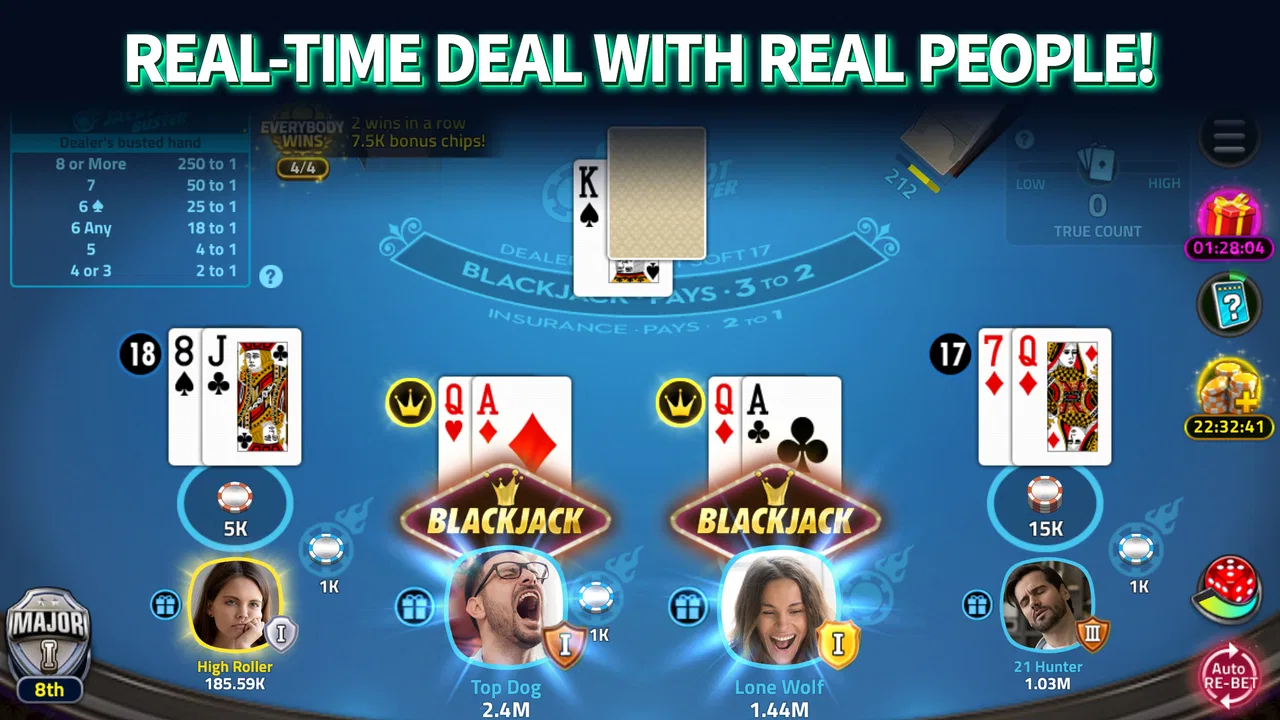
I spent time with House of Blackjack 21 as a social card game built around blackjack and casino-style play. Its main appeal is easy to understand: it gives you a free way to sit down for a few hands, enjoy the familiar goal of reaching 21 without going over, and bring friends into the experience through its face-to-face chat focus. It is not trying to replace a serious casino table or teach advanced card counting. Instead, it sits closer to a casual mobile game for people who enjoy blackjack with a more social atmosphere.
The game comes from MASSIVE GAMING PTY LTD and belongs to the card category. It has been available since February 6, 2018, and its current version is 1.11.13. That long presence matters to me because this is not a brand-new experiment that I would expect to understand in a single quick session. The game has had time to establish its particular style, and its audience is substantial, with over one million installs and an average rating of 4.1 from around 26 thousand ratings.
How the free entry and paid value work
The most important point for a new player is that the game is free to install. That makes it straightforward to try a few rounds before deciding whether its social casino format suits you. You do not need to commit money simply to find out whether the table presentation, pace, and interaction style are enjoyable. For a casual player, that free entry is a meaningful part of the value.
You May Also Like

 Blood Strike: 2.5 Anniversary
Blood Strike’s Loadouts Turn Every Drop Into a Tactical Gamble
A close look at Blood Strike’s custom loadouts: how fast access to signature weapons reshapes its battle royale rhythm, rewards preparation, and narrows the gap between fights.

 Pandora - Music & Podcasts
Pandora’s Music Is Easy to Start, but Harder to Recover
Pandora’s strength is its low-effort path from a seed to a station. Its weak spot is how much confidence it asks you to place in connection, setup, and quiet recovery.

 8 Ball Pool
 Is Built on Rivalries, Rematches, and Routine
A close look at the rivalries, rematches, shared routines, and unanswered safety questions that turn a quick pool match into a persistent mobile community.

 Samsung Music
’s Quiet Strength Is Playing What You Already Own
Its reach comes less from spectacle than from dependable access to a personal library. That simplicity is both the app’s strongest retention engine and its ceiling.

 AccuWeather: Weather Radar
AccuWeather Review: A Quick, Clear Forecast for Everyday Decisions
For everyday plans, the best forecast is the one you can understand quickly. AccuWeather makes rain timing, radar, and local conditions easy to act on, with a few trade-offs.

 Hill Climb Racing
Why Hill Climb Racing Still Turns Crashes Into One More Run
A tiny car, a bumpy hill and one more upgrade: Hill Climb Racing keeps resurfacing because its simple chaos makes every near-miss feel personal.
More From Our News Desk



There are in-app purchases ranging from $0.99 to $199.99 per item. I would treat that range as a reason to decide on a personal spending limit before playing, especially if you are the kind of person who enjoys quick repeat rounds and can be tempted to buy more during a losing streak. The presence of purchases does not make the free installation pointless, but it does change how I would approach the game: I would first test the experience without spending and only consider a purchase if I already knew exactly what extra value I wanted from it.
That distinction is useful because a free download can mean very different things in mobile casino games. Here, the sensible starting position is to see the free version as a trial and a casual entertainment option, not as a promise of unlimited premium enjoyment. The purchase range shows that optional spending can become much more significant than the initial download cost. I would therefore avoid treating the game like a completely cost-free pastime if you know you tend to chase progress through purchases.
The Teen content rating is another practical consideration. It tells me this is not aimed at young children, and it is better suited to older players who understand the difference between a game’s virtual casino atmosphere and real-money gambling. Parents choosing games for a shared device should pay attention to that rating and to the purchase settings on the device, rather than assuming that a card game is automatically appropriate for every age.
What you are really paying for
In my view, the paid value is less about learning blackjack and more about extending the social play loop. The basic rules of blackjack are familiar, so the game’s appeal depends on whether you like its way of presenting the table and interacting with other people. If you only want to practice decisions such as hitting or standing, a simple offline blackjack app may be a better fit because it can be more focused and less distracting.
On the other hand, if the attraction is sitting in a lively digital room and sharing the moment with friends, the social layer can justify spending more than a bare rules-based game would. I would still keep purchases strictly optional in my mind. The free access is enough to judge whether the atmosphere is worth returning to; money should come later, if at all, and only after the game has proved useful for your own routine.
How the blackjack experience feels in everyday use
Blackjack works well on a phone because individual rounds are naturally short. I could imagine opening the game during a quiet break, playing a few hands, and closing it without needing to reserve a long uninterrupted session. That makes it more approachable than a strategy-heavy card game that requires a full match or a large amount of concentration before reaching a satisfying stopping point.
The familiar target of 21 also lowers the learning barrier. Someone who knows only the broad idea of blackjack can understand the purpose quickly, while a more experienced player can focus on the decisions rather than learning a complicated new rule set. That accessibility is one of the strongest reasons to recommend it to friends who want a casual card game rather than a demanding competitive title.
The social emphasis changes the mood, though. I would not choose this game when I want a quiet, purely analytical session. Face-to-face chat and the presence of friends can make a win feel more entertaining, but they can also add noise and distraction. A player who prefers to calculate every decision carefully may find that the social setting competes with the card play instead of improving it.
One useful way to approach it is to separate your sessions by purpose. When I want light entertainment, I would join friends and allow the conversation to be part of the game. When I want to improve my blackjack decisions, I would use a slower, more focused alternative and think through the choices without the pressure of a social table. Expecting one mobile game to perform both jobs equally well is likely to lead to disappointment.
A realistic use case for friends
Imagine a small group of friends who cannot meet at the same table but want something more interactive than sending messages. House of Blackjack 21 can fill that gap by giving the conversation a shared activity. Instead of discussing what to play, everyone already understands the basic premise, so the group can spend its time reacting to hands, joking about unlucky cards, and deciding when to leave the table.
The trade-off is that the group needs compatible schedules and a willingness to stay engaged. If one person joins only briefly or does not enjoy casino-themed games, the social benefit becomes weaker. In that situation, a general multiplayer card game may be easier to recommend because it does not depend as heavily on everyone liking blackjack specifically.
I also think it works best for small, informal sessions rather than treating every round as a serious contest. The more pressure you put on results, the more the purchase system and random outcomes may affect the mood. Keeping the game in the category of shared entertainment helps preserve its strongest quality: it gives friends a common activity without requiring them to master a complicated ruleset.
Specific strengths that are easy to overlook
One less obvious strength is how easily the game can act as a social bridge. Many card games are technically multiplayer but still feel like solitary play with other people somewhere in the background. The face-to-face chat focus gives House of Blackjack 21 a clearer reason to invite friends. If your group already enjoys talking while playing cards, that connection may matter more than extra complexity.
A second strength is the low commitment of a blackjack round. You can use it as a short activity between longer tasks instead of planning an entire evening around it. That makes it a practical choice for players who want a game with a natural rhythm of joining, playing, and leaving. I would still avoid opening it when I need to concentrate on work, because the quick-round structure can make “one more hand” surprisingly easy to justify.
A third useful insight is that the game can serve as a social test before any spending decision. Because installation is free, I would invite friends, try the basic experience, and watch how often the group actually returns. If the game becomes part of your regular conversations, then you have evidence that its social value is real for you. If everyone stops after one session, buying anything would be difficult to justify.
There is also a psychological trade-off in the familiar blackjack format. Familiar rules make the game welcoming, but they can make losses feel repetitive rather than educational. A new strategy game often gives you a clear lesson after a mistake; blackjack can leave you feeling that you made the reasonable choice and simply received an unfavorable result. Players who need visible skill progression should keep that limitation in mind.
Where the experience may create friction
The biggest friction is the relationship between casual play and optional purchases. The game is free to begin, but the listed purchase range reaches from $0.99 to $199.99 per item. That does not tell me what every purchase delivers, so I would not assume that spending automatically improves the experience. I would make a rule before playing: no buying during frustration, no chasing a bad run, and no treating virtual progress as a financial recovery.
Another limitation is that the game’s strongest feature depends on other people. If you normally play alone, the social presentation may not add enough to compensate for the distractions of a chat-oriented environment. A traditional solo blackjack app could be better for practicing, relaxing quietly, or playing without coordinating with friends.
The Teen rating also means I would not present it as a family game for children. Even if a child understands cards, the casino framing and purchase options make it a poor choice for unsupervised younger players. For adults and older teens who can handle the theme responsibly, the rating is less of a problem, but it is still worth taking seriously when sharing devices or accounts.
Device compatibility is reasonably broad for an older Android title because the minimum requirement is Android 6.0. That helps players with devices that are not running the newest operating system. Still, an older supported operating system does not guarantee that every phone will feel equally smooth or that every social session will be equally comfortable. I would pay attention to how clearly the table and chat elements appear on your screen, especially if you use a smaller phone.
Who will get the most value from it?
I would recommend this game first to people who already enjoy blackjack and want a social version they can share with friends. It is also a good candidate for someone who wants short sessions, recognizes the basic card values, and prefers conversation over deep strategy. The free installation makes the decision easy: try it with the people you actually expect to play with, not only in a solo test.
It may also suit players who like casino-style presentation but do not want the complexity of a broader card-game collection. The central activity is easy to understand, and that simplicity can make it useful for a mixed-skill group. Experienced players can join without teaching a long rulebook, while newcomers can learn through familiar decisions.
I would steer away from it if your main goal is serious blackjack training. The social focus is not the same as a structured lesson, and the entertainment setting may encourage quick choices rather than careful analysis. In that case, a dedicated blackjack trainer or a quiet offline alternative would be more appropriate, even if it feels less lively.
I would also skip it if you are uncomfortable with in-app purchases or casino-themed reward loops. The free price is helpful, but the possibility of purchases up to $199.99 per item means you should be confident in your spending boundaries. If that sounds stressful rather than entertaining, a paid game with a clear one-time cost may offer better peace of mind, provided its price and model suit you.
Finally, it is not the best choice for people who want a card game that rewards long-term planning, deck construction, or a large competitive skill tree. House of Blackjack 21 is built around the immediate tension of each hand and the social enjoyment around it. Players looking for collectible-card depth or a campaign with substantial progression should look elsewhere.
My verdict after weighing the trade-offs
My recommendation is conditional but positive. House of Blackjack 21 is worth trying if you want free access to a social blackjack experience and already have friends who would enjoy joining you. Its average rating of 4.1, supported by around 26 thousand ratings and more than six thousand reviews, suggests that it has found an audience, while its large install base shows that the concept is easy for many players to pick up.
I would not recommend spending immediately. The best value comes from testing the free experience, seeing whether the chat-centered format actually brings your group back, and deciding whether the entertainment justifies any optional purchase. That approach keeps the free entry genuinely useful instead of turning the game into an impulse-buy environment.
For me, the deciding question is simple: do you want blackjack as a shared social activity, or do you want blackjack as a focused practice tool? If the first answer is yes, this game has a clear reason to exist and can make short sessions with friends more enjoyable. If the second answer is yes, choose a more specialized alternative. Try it for the social table, keep spending optional, and skip it if the casino atmosphere is not what you want from a card game.
FAQs for House of Blackjack 21
01What is House of Blackjack 21?
House of Blackjack 21 is a mobile gaming app that brings the classic casino experience of Blackjack to your Android or iOS device. It offers a realistic gaming environment with intuitive controls, making it easy for both beginners and seasoned players to enjoy. The app includes various features like multiplayer modes, daily challenges, and leaderboards.
02Is House of Blackjack 21 free to play?
Yes, House of Blackjack 21 is free to download and play. However, the app may include in-app purchases for additional chips, special features, or premium content. These purchases are optional, and players can enjoy the game without spending money, though progressing faster might require some purchases.
03Does House of Blackjack 21 require an internet connection?
An internet connection is required to access certain features of House of Blackjack 21, such as multiplayer modes, leaderboards, and daily challenges. However, the game also offers offline modes where you can play against AI opponents, allowing you to enjoy the game without an internet connection.
04Are there any age restrictions for playing House of Blackjack 21?
Yes, House of Blackjack 21 is designed for players aged 17 and above. The game simulates a casino environment, which may not be suitable for younger audiences. It’s important for parents to monitor their children's app usage and ensure that they adhere to the age restrictions.
05How can I improve my skills in House of Blackjack 21?
To improve your skills in House of Blackjack 21, take advantage of the app's tutorial mode and practice regularly. Understanding basic Blackjack strategies, such as when to hit or stand, can significantly enhance your gameplay. Participating in daily challenges and multiplayer matches can also provide valuable experience and insights.
Pros
- Intuitive user interface enhances gameplay.
- Variety of game modes keeps it engaging.
- Real-time multiplayer option available.
- Daily bonuses and rewards are generous.
- Smooth graphics and animations.
Cons
- Requires constant internet connection.
- In-app purchases can be pricey.
- Ads can interrupt gameplay frequently.
- Limited customization for avatars.
- Occasional server connectivity issues.

House of Blackjack 21
Gallery